

What Makes a Barcelona Apartment Hold Its Value?
Barcelona property values depend on more than location. Discover how principal floors, natural light, building condition, rental rules and buyer demand influence long-term appeal.
What should you look for before buying?
Barcelona has a finite stock of historic buildings, but architectural charm alone does not make a sound purchase. A successful purchase balances location, light, layout, legal certainty, maintenance costs and the number of people likely to want the home when it is time to sell.
One useful question to ask early is: who would buy this apartment in five or ten years? A principal-floor apartment with period features may appeal to design-conscious buyers; a bright upper-floor home with a lift and terrace may appeal to a wider range of households. Neither is automatically the better investment. The purchase price and any compromises matter.
1. Micro-location matters more than a postcode
Within Eixample, two comparable apartments can feel completely different. One might overlook a busy avenue; another a quiet interior courtyard (pati d’illa). Proximity to Passeig de Gràcia or Rambla de Catalunya offers centrality, while quieter streets in Esquerra de l’Eixample can offer a more residential atmosphere.
In Gràcia, the appeal may be its neighbourhood squares and smaller streets; in El Born or the Gothic Quarter, historic character comes with questions about access, noise and natural light. Compare the street, building frontage and nearby amenities—not just the neighbourhood label.
For context, Idealista reported average asking prices of €5,462/m² across Barcelona in September 2026, compared with €6,648/m² in Eixample and €5,654/m² in Gràcia. These are advertised prices, not completed transactions or valuations of individual apartments. Street, condition, size and floor level can substantially change the comparison.
2. The principal floor: historic prestige with practical trade-offs
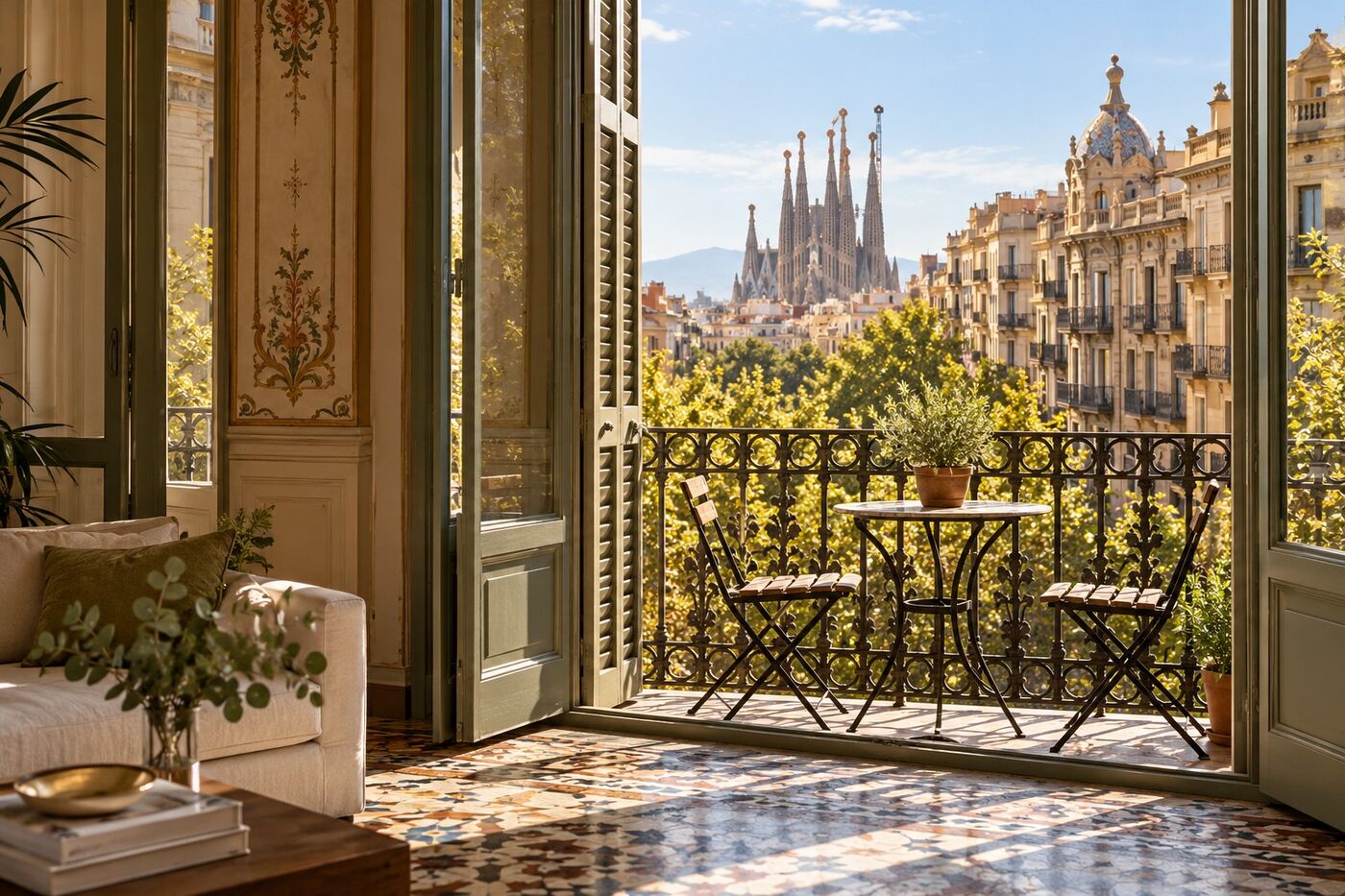
In many 19th- and early 20th-century buildings, the principal floo, —often above a ground-floor premises or entresòl (mezzanine), was designed for the owner or wealthiest residents. It may have higher ceilings, generous reception rooms, ornate mouldings, tall windows and more elaborate carpentry than apartments above it.
These proportions are an important part of Barcelona’s architectural appeal. However, a principal is not automatically the most valuable flat in a building. Lower floor levels may mean less daylight or privacy. Judge the ceiling height alongside orientation, street width, condition and access.
3. Modernisme and original details: character, not a guarantee
Catalan Modernisme flourished during Barcelona’s late-19th- and early-20th-century expansion. Architects including Antoni Gaudí, Lluís Domènech i Montaner and Josep Puig i Cadafalch helped shape the city’s residential architecture. Beyond celebrated buildings such as Casa Batlló, period homes can feature decorative ironwork, colourful ceramics, stained glass and striking entrance halls.
Original hydraulic cement tiles (suelos hidráulicos), wooden shutters, plaster mouldings and glazed interior galleries can make an apartment memorable. Some homes also have vaulted brick or tile ceilings; the term volta catalana more specifically describes thin-tile vault construction, so not every exposed brick ceiling should be labelled as such.
Authenticity and preservation are worth investigating, but the aim is a home that also works: reliable plumbing, updated electrics, efficient heating and cooling, comfortable acoustics and a practical layout. A renovation that retains attractive original features without compromising comfort can appeal to both character-focused and everyday buyers.
4. Light, layout and Eixample’s distinctive urban plan
Ildefons Cerdà’s Eixample plan was approved in 1860. Its grid, broad streets and chamfered corners (xamfrans) help explain why apartments can have such different exposures. A street-facing balcony may offer urban views but more traffic noise. A rear gallery or courtyard-facing room may be quieter, though daylight varies significantly.
Corner apartments can have more windows or different orientations; a corner address alone does not guarantee brightness. Visit at different times of day where possible. Check winter sun, summer overheating, ventilation and shading. For upper floors, confirm lift access: views and a terrace may not offset several flights of stairs for every future buyer.
Layout matters just as much. Older apartments may have long corridors and smaller rooms. Before assuming walls can be removed, have an architect review structural constraints, shared installations and any protected features.
5. Outdoor space: inspect its use and legal status
A balcony, gallery or terrace can extend everyday living in Barcelona. Yet a narrow traditional balcony is not equivalent to a terrace large enough for dining. Consider privacy, access from the main rooms, sun exposure, wind and practical usable space.
Crucially, check the title documents and community statutes. Some rooftop terraces belong to the community but are assigned for exclusive use to an apartment. Exclusive use is not the same as private ownership and can affect alterations and maintenance responsibilities.
6. Building condition can outweigh a beautiful interior
An immaculate renovation does not resolve a leaking roof, failing downpipes or expensive façade works. Before buying a historic apartment, examine the community’s meeting minutes, accounts, approved works, any major pending works and extraordinary contributions (derramas). These can create unexpectedly high costs.
In Catalonia, the Inspecció Tècnica d’Edificis (ITE) generally applies to residential buildings once they are over 45 years old, subject to relevant rules and exemptions. Request the inspection report, any associated certificate of fitness (certificat d’aptitud), and evidence of how identified defects are being addressed. An ITE is a visual building inspection, not a guarantee against hidden defects.
Check whether the building is heritage-protected, because façade changes, windows or internal works may require additional permissions. For older buildings, the financial health of the community can be as important as the finish of the apartment.
7. Regulations and energy efficiency affect investment decisions
For buy-to-let purchasers, rental assumptions must be verified before calculating yield. Barcelona is a declared stressed residential market area (zona de mercado residencial tensionado), where legal rent limits apply to qualifying residential leases. The applicable ceiling can depend on the property, the previous rent and the landlord’s status. Do not assume that a furnished or shorter lease is automatically outside residential regulation; the genuine purpose and current legal classification matter.
Tourist rental licensing is a separate issue. Barcelona City Council has stated its intention not to renew 10,101 tourist-flat licences in 2028. That is a stated policy direction with significant implications for future income assumptions, not proof that any particular apartment has—or will retain—tourist-use rights. Verify the licence, planning status and applicable rules for the individual property.
Also review the energy performance certificate and its A–G rating, together with window quality, insulation and cooling/heating systems. Energy ratings and running costs affect comfort and renovation planning; a strong rating does not, by itself, establish a resale premium. A valid energy certificate is generally required for a property sale, subject to exemptions.
8. Think like the next buyer, not just today’s buyer
Ask which compromises a future purchaser would accept. A design-led buyer might prize a principal floor’s ceilings and hydraulic tiles. A family might choose a lift, flexible bedrooms and reliable climate control. A second-home purchaser may value an easy-to-maintain apartment and outdoor space.
The strongest resale proposition usually combines qualities people can assess immediately, light, sensible distribution, a good address, with the less visible factors that buyers uncover during due diligence: sound building management, manageable future costs and clear legal documentation. No feature guarantees appreciation; paying a sensible price is essential.
Get the details right before you buy
A Barcelona apartment should be evaluated as both a home and a long-term asset. At Urbane International Real Estate, we help buyers compare properties on their architecture, day-to-day comfort, building condition, legal documentation and resale audience—not photographs alone.
Ask our team for a Barcelona building-condition checklist before your next viewing, or explore our current apartments for sale: https://www.urbanegroup.es/en/buy
Considering a principal-floor apartment? Share the listing with us and we can help identify the questions worth asking before you commit.