

The Hidden Costs of Owning Property in Barcelona: What International Buyers Should Budget Each Year
A practical guide to the annual taxes, community fees, maintenance costs and other ongoing expenses international owners should consider when buying property in Barcelona.
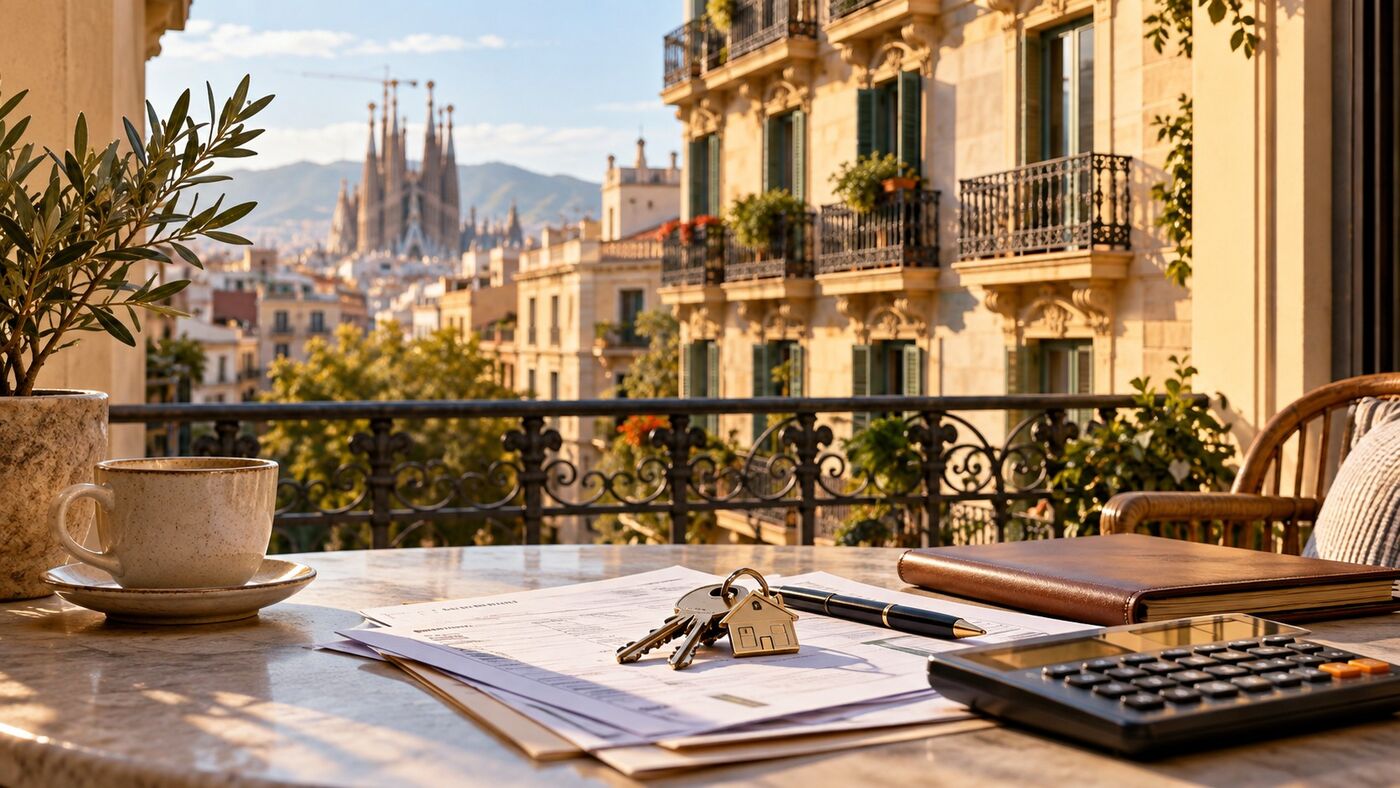
Buying a property in Barcelona is often discussed in terms of the purchase price, taxes and costs involved in completing the transaction. However, once the keys have been handed over, property ownership comes with a second set of costs that international buyers should also take into account.
Fortunately, the ongoing cost of owning a home in Barcelona is generally quite manageable. But the exact amount can vary considerably depending on the property, the building, whether it is used as a second home or rented out, and whether the owner is resident in Spain.
At Urbane International Real Estate, we work with many international owners who live outside Barcelona for all or part of the year. Here are some of the main annual costs we recommend considering before buying.
1. IBI – Barcelona's Annual Property Tax
The first recurring tax most property owners will encounter is the Impuesto sobre Bienes Inmuebles, normally referred to simply as IBI.
IBI is a municipal property tax paid annually by the owner of the property. Importantly, it is not calculated directly from the purchase price or current market value of the apartment. Instead, it is based on the property's base liquidable, which is derived from its cadastral value.
For 2026, Barcelona's general IBI tax rate for urban property is 0.75% of the applicable taxable base, according to Barcelona City Council's current fiscal ordinance.
This means two apartments that sell for a similar market price can have different IBI bills depending on their cadastral characteristics.
When considering a property, we therefore recommend asking to see the latest IBI receipt rather than trying to estimate the amount from the advertised sale price.
2. Community Fees
If you buy an apartment in Barcelona, you will normally become part of the building's comunidad de propietarios, or community of owners.
Community fees pay for the maintenance and running of the shared parts of the building. Depending on the property, this can include the lift, cleaning of common areas, electricity, building insurance, concierge services, gardens, swimming pools and general building maintenance.
There is no standard community fee in Barcelona.
A simple building without a lift or concierge may have relatively low running costs, while a luxury development with communal facilities, security, parking, gardens or a swimming pool can cost considerably more.
Under Catalan property law, owners normally contribute to common expenses according to their participation quota in the building, unless the title, statutes or community agreements establish another method.
For buyers, the most important point is not simply to ask "How much is the community fee?"
It is also worth understanding what that fee covers.
3. Special Assessments: The Cost Buyers Sometimes Forget
One of the most important things to investigate before buying an apartment in Barcelona is whether the community has approved, or is considering, any extraordinary building works.
These extraordinary contributions are commonly known as derramas.
A community may need additional funds for works such as repairing the façade, replacing a lift, renovating the roof, improving accessibility or carrying out major structural or energy-efficiency works.
In Barcelona, this can be particularly relevant when purchasing in older buildings in neighbourhoods such as Eixample, Gràcia or Ciutat Vella.
The normal monthly community charge may look perfectly reasonable, but a major façade or lift project can create a much larger one-off expense.
This is why reviewing the minutes of recent community meetings and checking whether any extraordinary works have been approved is an important part of the due-diligence process.
At Urbane, this is one of the areas we look at carefully when assisting buyers. Sometimes the condition and financial situation of the building can be just as important as the condition of the apartment itself.
4. Non-Resident Property Tax
This is one of the costs that surprises international owners most often.
If you are not tax resident in Spain and own an urban property here that you use yourself or keep available for your own use, Spain may tax you on a form of imputed property income, even though the property has not actually generated rental income.
The Spanish Tax Agency calculates this notional income using the property's cadastral value.
Under the current rules, the calculation generally uses either 1.1% or 2% of the cadastral value, depending on when the cadastral value was revised.
Barcelona's latest general cadastral valuation entered into effect in 2018. Under the current rules, this means Barcelona properties can fall within the 1.1% calculation while that revision remains within the relevant ten-year period.
The resulting imputed income is then taxed at the applicable non-resident income-tax rate.
According to the Spanish Tax Agency, the general rates are currently:
19% for qualifying residents of the European Union, Iceland, Norway and Liechtenstein.
24% for other non-resident taxpayers.
For example, if an apartment had a cadastral value of €200,000 and the 1.1% calculation applied, the taxable imputed income would be €2,200. A taxpayer subject to the 19% rate would therefore pay approximately €418, while at the 24% rate the amount would be approximately €528.
This is a simplified example. Individual circumstances matter, and international owners should always obtain tax advice relevant to their country of residence and personal situation.
If the property is rented for part of the year, rental income taxation applies to the rental period, while imputed income may apply proportionally to the period during which the property was available for the owner's own use.
5. Household Waste Charges
Barcelona also applies a municipal charge for the collection of household waste.
The amount is linked to the property and household water consumption, and Barcelona City Council establishes different categories and tariffs.
It is not usually one of the largest costs involved in owning a property, but it is another item buyers should include when looking at the real annual cost of ownership rather than simply the mortgage or purchase price.
When reviewing a property, existing utility bills can help give a more accurate picture of these recurring charges.
6. Home Insurance
Home insurance is another cost that should form part of an owner's annual budget.
The price will depend on factors including the value and size of the property, the level of contents cover, the age of the apartment and the type of protection selected.
Owners who rent their property may also require different coverage from someone using the apartment exclusively as a second home.
It is also important to understand what is covered by the building's community insurance and what needs to be insured privately.
Choosing the cheapest policy without reviewing these differences can become expensive when an incident actually occurs.
7. Maintenance and Repairs
Every property requires maintenance, and Barcelona's housing stock ranges from brand-new developments to apartments in buildings more than a century old.
Owners should therefore keep a reasonable contingency budget for repairs and preventative maintenance.
Air-conditioning systems, boilers, appliances, plumbing, electrical installations, shutters and windows can all require attention over time.
In older buildings, preventative maintenance becomes particularly important. Dealing with a small leak or servicing an air-conditioning system early is normally much less expensive than dealing with the resulting damage later.
For international owners, there is an additional consideration: somebody needs to identify the problem in the first place.
A small water leak can go unnoticed for weeks if a second home is empty.
8. Utilities and Services
Electricity, water, gas and internet are obvious expenses when the property is occupied, but some charges continue even when it is empty.
Most utility contracts contain fixed elements, so keeping an apartment in Barcelona available as a second home still creates a baseline running cost.
Owners may also choose to maintain an alarm system, internet connection or other services throughout the year.
The precise figure depends very much on how the property is used, so instead of relying on an average, we normally recommend examining the actual bills for the property whenever possible.
9. Property Management for International Owners
Property management is optional, but for owners living abroad it can be one of the most useful costs to budget for.
Owning a property several thousand kilometres away is very different from owning one around the corner.
Someone may need to collect correspondence, supervise repairs, represent the owner at community meetings, coordinate insurance claims, organise utility changes, inspect the property, prepare it before the owner's arrival or deal with an emergency while the owner is overseas.
If the property is rented, management can also include tenant communication, rent collection, contracts, check-ins and check-outs, maintenance, tax documentation and compliance with changing rental regulations.
Professional management therefore adds another recurring expense, but for many international owners it turns Barcelona property ownership from an administrative responsibility into a genuinely passive asset.
So, How Much Does It Cost to Own a Property in Barcelona Each Year?
There is no reliable single percentage that applies to every property.
A modern apartment in a building with few communal services may have relatively modest annual running costs. A large property in a luxury development with concierge service, parking, swimming pool and extensive communal facilities will naturally cost more.
The best way to calculate the real cost is property by property.
Before completing a purchase, we recommend checking:
the latest IBI receipt, current community fees, recent community meeting minutes, any approved or proposed derramas, insurance requirements, recent utility costs, the property's cadastral value and the owner's likely Spanish tax obligations.
For higher-value properties and international owners with significant assets in Spain, it is also important to obtain professional tax advice regarding any additional Spanish wealth-related taxes that could apply.
Looking Beyond the Purchase Price
Buying property in Barcelona remains attractive to international purchasers, but a good investment decision should always be based on the total cost of ownership, rather than simply the acquisition price.
The important point is not that property ownership in Barcelona carries unusually high expenses. In many cases, annual running costs are relatively reasonable.
The important point is knowing about them before you buy.
Understanding the building, its accounts, its maintenance history and the property's tax position can help avoid unexpected expenses later and gives buyers a much clearer picture of what a particular apartment will really cost to own.
At Urbane International Real Estate, we assist international buyers throughout the purchase process and continue supporting owners after completion through our post-sales, property management, rental management and tax-support services.
If you are considering buying a property in Barcelona and would like to understand not only what it costs to buy, but what it will cost to own, contact our team and we will be happy to help.