

The cadastral reference value in Barcelona property purchases: what it is and how it affects ITP
A practical guide for buyers and sellers on how the cadastral reference value works and why it does not always reflect the market
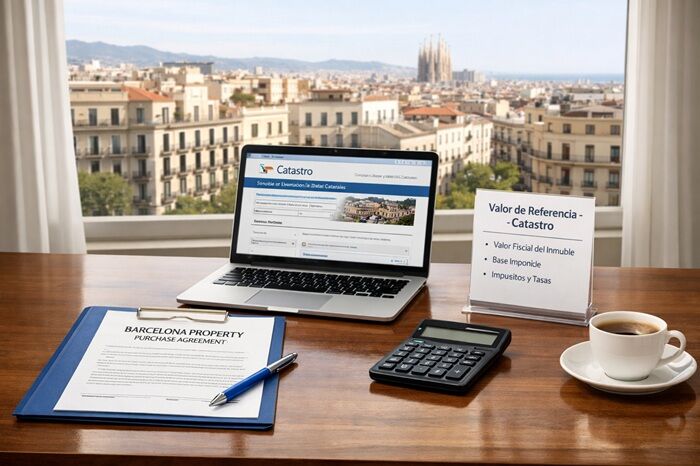
What the reference value is in Barcelona
The reference value is an amount set by the Catastro that the tax authorities use as a minimum benchmark for calculating taxes on property purchases, such as the Transfer Tax (ITP) in Catalonia.
In a purchase‑sale transaction subject to ITP, the taxable base cannot be lower than this reference value. If the declared price is lower, the Administration may apply the reference value as the minimum base, even if the buyer actually pays and signs for a lower amount.
Why the reference value does not reflect the market
The reference value was introduced as a fiscal tool to reduce discrepancies between the real market price and the amount declared, avoiding artificially low tax bases. In Catalonia, it mainly affects:
- Onerous property transfers (second‑hand residential property sales subject to ITP).
- Gratuitous property transfers (gifts or donations).
- Inheritances (ISD) and certain stamp duties (AJD) when the property has an active reference value.
However, the reference value is calculated in a mass, statistical way, based on zoning maps and average values for homogeneous areas, without individually assessing factors such as condition, renovations, views, orientation, or urgency of sale. As a result, in highly diverse areas of Barcelona (such as Eixample or Sarrià‑Sant Gervasi) it can clearly sit above or below the actual market price.
ITP when the sale price is lower than the reference value
Imagine you buy a second‑hand flat in Barcelona subject to ITP. The contract reflects a sale price of 300,000 €, but the cadastral reference value is 330,000 €.
In this case, the tax authorities understand that the taxable base cannot be lower than the reference value. Even if the buyer pays and declares 300,000 €, the Administration may apply 330,000 € as the minimum base and, where necessary, adjust the tax due.
Practical example 1 – Sale price below the reference value
- Sale price agreed: 300,000 € (originally declared).
- Cadastral reference value: 330,000 €.
- ITP rate in Catalonia (second‑hand residential): 10 %.
In this scenario:
- Taxable base for ITP: 330,000 € (because it is higher than the agreed price).
- ITP payable:
330,000 × 10 % = 33,000 €.
If the buyer initially paid only 30,000 € based on 300,000 €, the tax authority may require the extra 3,000 €, unless the self‑assessment is corrected or the reference value is properly challenged before the tax is finalised.
ITP when the sale price is higher than the reference value
Now imagine the buyer and seller agree on a price higher than the reference value, because the property has very attractive features (recent renovation, terrace, excellent location, etc.).
In this case, the reference value still acts as a floor, but the taxable base becomes the higher of the two values: the sale price, provided it is substantiated and properly documented.
Practical example 2 – Sale price above the reference value
- Sale price agreed: 380,000 €.
- Cadastral reference value: 350,000 €.
- ITP rate in Catalonia (second‑hand residential): 10 %.
In this scenario:
- Taxable base for ITP: 380,000 € (because it is higher than the reference value).
- ITP payable:
380,000 × 10 % = 38,000 €.
The reference value does not cap the real price: the tax is calculated on the actual market‑based purchase price, not on the cadastral benchmark.
What you can do if the reference value seems misaligned
When the reference value appears clearly higher or lower than the real market price, the taxpayer can take several steps:
1. Correcting or revising the self‑assessment
If you have already paid the ITP and believe the reference value does not fit the case, you can lodge a correction of the self‑assessment within the legal time limits. The tax authority will review the base and may accept the adjustment, or refer the file to the Catastro for a review of the reference value.
2. Appealing the assessment
If you receive an assessment that applies the reference value and you consider it unfair, you can file an administrative appeal and, if applicable, a subsequent economic‑administrative claim. The tax authority does not directly change the reference value itself; instead, it forwards the documentation to the Catastro, which may confirm or modify it.
3. Preventive steps before signing
- Check the reference value on the Catastro’s online portal before finalising the sale.
- Assess with a surveyor or real‑estate advisor whether the reference value is reasonably aligned with the current market price.
- Plan your tax strategy (timing, documentation and possible challenges) in case a high reference value could significantly increase the ITP cost.
Practical considerations for buyers and sellers in Barcelona
For buyers:
- Do not confuse the reference value with a market valuation or a bank appraisal. It can help estimate the ITP, but it is not proof that the property is actually worth that amount.
- If you see a clear mismatch, discuss with your legal or tax advisor the possibility of correcting or challenging the reference value before the transaction is closed.
For sellers:
- Even though you do not pay the ITP, the buyer does, and a high reference value can make the transaction seem more expensive or less attractive.
- Before listing the property, it is useful to know whether it has an active reference value and how that might influence buyer interest.
Conclusion
The cadastral reference value in Barcelona is a standardised fiscal tool designed to curb under‑declaration of property values, not a precise reflection of the real estate market. Understanding how it affects ITP – and seeing examples where the taxable base is either lower or higher than the reference value – helps buyers and sellers anticipate the tax impact and make more informed decisions.